
How to Set Up a Microsoft Teams Bot with Unified

Updated:


April 20, 2026

Overview

If your Microsoft Teams bot connection is created successfully in Unified but later API calls fail with

No authorization information present on the request, the issue is usually not OAuth.

OAuth connects Microsoft 365 to Unified, but your bot still needs to be:

  • packaged correctly
  • uploaded to Teams
  • installed in the correct Team, channel, or chat

Without this, API calls will fail due to missing context.


⚠️ Important Clarification (Common Issue)

  • The manifest downloaded from Microsoft Entra app registration is NOT a valid Teams manifest
  • The Microsoft 365 schema is also not the correct reference

You must use the Microsoft Teams manifest schema:

https://learn.microsoft.com/en-us/microsoftteams/platform/resources/schema/manifest-schema

Using the wrong manifest will result in errors like:

Manifest parsing error message unavailable


What You'll Need

Before starting:


Create a Valid Teams App Package

Your .zip must include:

  • manifest.json
  • Color icon (192×192 PNG)
  • Outline icon (32×32 PNG)

Instead of writing JSON manually, use:

👉 Teams Developer Portal

https://learn.microsoft.com/en-us/microsoftteams/platform/concepts/build-and-test/teams-developer-portal

This allows you to:

  • Configure your bot via UI
  • Set scopes correctly
  • Generate a valid app package
  • Avoid manifest parsing errors

Manifest Checklist

Ensure your manifest.json includes:

  • Valid app ID
  • Bot capability with correct botId
  • Required scopes:
    • team
    • groupchat
    • personal (optional)

Use:

  • team → for channels
  • groupchat → for chats

Minimal Manifest Template (Reference)

{
  "$schema":"https://developer.microsoft.com/en-us/json-schemas/teams/v1.16/MicrosoftTeams.schema.json",
  "manifestVersion":"1.16",
  "version":"1.0.0",
  "id":"YOUR-APP-ID",
  "name": {
    "short":"My Teams Bot",
    "full":"My Teams Bot"
  },
  "description": {
    "short":"Bot for Teams",
    "full":"Bot for Teams integrated with Unified"
  },
  "developer": {
    "name":"Your Company",
    "websiteUrl":"https://yourdomain.com",
    "privacyUrl":"https://yourdomain.com/privacy",
    "termsOfUseUrl":"https://yourdomain.com/terms"
  },
  "icons": {
    "color":"color.png",
    "outline":"outline.png"
  },
  "accentColor":"#FFFFFF",
  "bots": [
    {
      "botId":"YOUR-ENTRA-APP-ID",
      "scopes": ["team","groupchat"]
    }
  ]
}

⚠️ Notes (Follow as Steps)

  1. Replace YOUR-APP-ID and YOUR-ENTRA-APP-ID with your actual app ID
  2. Ensure both icons exist in the .zip file
  3. Use this only as a reference template, not a full production manifest

Upload the App in Microsoft Teams

Steps:

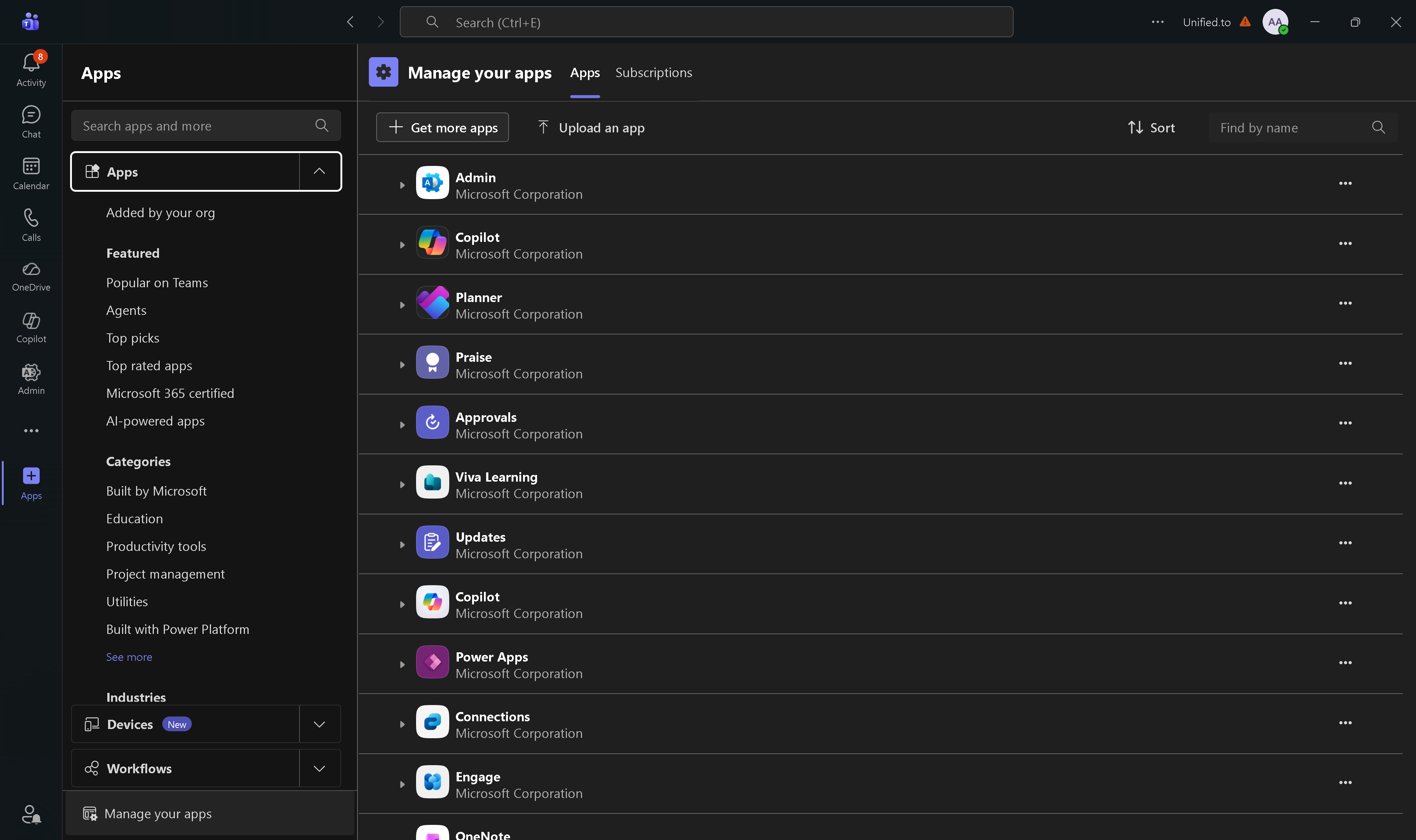
  1. Open Apps (left sidebar)
  2. Click Manage your apps
  3. Stay on Apps tab
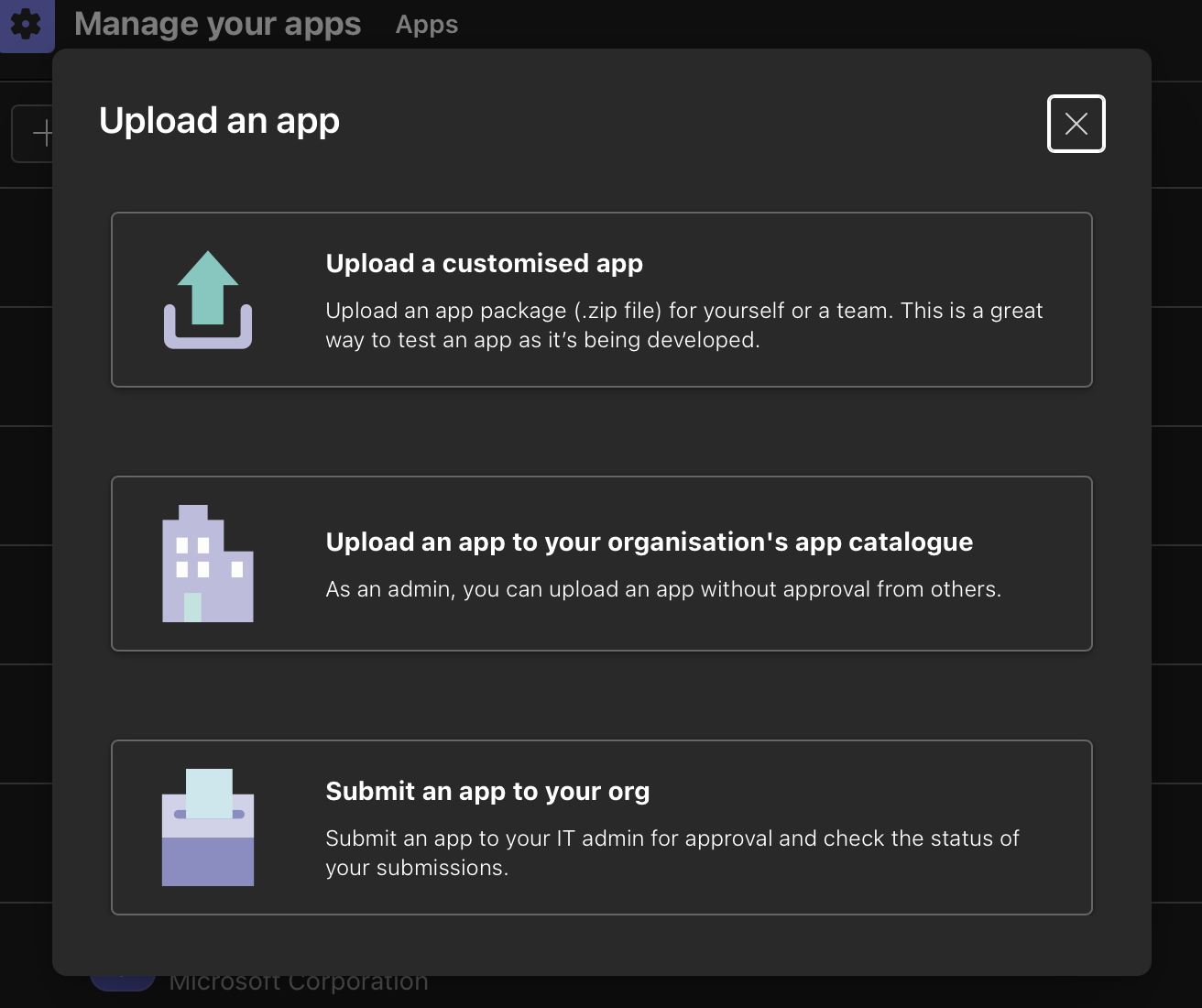
  4. Click Upload an app
  5. Upload your .zip

image.png

⚠️ If upload option is missing → admin restriction


Install the Bot in the Right Scope

Uploading ≠ installing

You must install the bot in:

  • A Team
  • A channel
  • A group chat
  • Personal scope

image.png

⚠️ If not installed → API calls will fail


Connect Microsoft Teams (bot) to Unified

Steps:

  1. Create connection in Unified
  2. Complete OAuth
  3. Approve scopes
  4. Save connection

Common Required Scopes

  • Channel.ReadBasic.All
  • ChannelMessage.Read.All
  • ChatMessage.Read
  • Chat.Read
  • ChannelMessage.Send
  • ChatMessage.Send
  • offline_access

💡 If permissions change → reconnect integration


Test the Connection

  1. Send a message where the bot is installed
  2. Call Unified messaging API
  3. Verify read/send works

💡 If connection was created before installation → retry


Troubleshooting

❌ Manifest parsing error

  • Wrong manifest type (Entra instead of Teams)
  • Wrong schema

❌ App package failed validation

  • Missing icons
  • Files not at root
  • Invalid JSON
  • botId mismatch

❌ No authorization information present

  • Bot not installed in correct scope
  • Missing permissions
  • Wrong scope
  • Token outdated → reconnect
Share
All guidesAdvertising Report Metrics by IntegrationATS to Vector DB: How to Power Talent Intelligence with Real-Time DataBuilding AI applications with Unified and LangbaseConcur & Concur (Company) — Connection GuideConfigure Greenhouse Native Candidate WebhooksConnect Amazon Seller Central to Unified.toConnecting BambooHR via OAuth 2Connecting Google Workspace Integrations with a Service AccountCorrect WelcomeKit Scopes for Jungle IntegrationCreating Ads using the Unified Ads APICreating Walmart Items via UnifiedEnd-Users, Integrations, and ConnectionsEnriching Unified Objects with Custom MetadataEnterprise-managed authorization (EMA) with a static keyEnterprise-managed authorization (EMA) with a workspace secretEnterprise-managed authorization (EMA) with Microsoft Entra IDExtended observability — pushing API logs to ClickHouseExtended observability — pushing API logs to Grafana / LokiExtended Observability - Pushing API Logs to your Datadog InstanceFacebook Messenger Webhook SetupFireflies Integration GuideGetting started with WorkableHandling Delegated vs. Application Scopes in Microsoft IntegrationsHiBob & Unified: connection and time off guideHow long are logs retainedHow to access employees and usersHow to add API support for the Create Activity in CrelateHow to Associate a Connection ID with Your End-UserHow to build a Candidate Assessment product with Unified.toHow to build a candidate sourcing or job board app with Unified.toHow to build a Discord support bot with Unified.to and LangbaseHow to Build a Fintech Application with Unified's Payments APIHow to Build an E-Commerce Product Integration with UnifiedHow to build an invoicing system with Unified.toHow to build Enterprise Search using RAGHow to configure Bullhorn Redirect URI for creating a connectionHow to configure webhooks in HubSpotHow to configure webhooks in Thrive LearningHow to configure webhooks in Toast for UnifiedHow to Connect Anthropic to Real-Time SaaS Data with Unified.to MCP ServerHow to Connect Cohere to Real-Time SaaS Data with Unified.to MCP ServerHow to Connect Google Gemini to Real-Time SaaS Data with Unified.to MCP ServerHow to Connect LLMs to Real-Time SaaS Data with Unified.to MCP ServerHow to Connect OpenAI to Real-Time SaaS Data with Unified.to MCP ServerHow to Connect Zoom and Zoom PhoneHow to create a Connection In Microsoft TeamsHow to create a token-based connection in HighlevelHow to Create a Unified.to Connection to HighLevelHow to Create a Xero Connection in Unified.toHow to create and configure webhooksHow to create Connection with HubspotHow to customize portal URLs for Stripe and GoCardlessHow to filter webhook eventsHow-to Get a Private Support Channel for Your Unified IntegrationHow to get your 8x8 Connect API Key and Account ID: Step-by-step guideHow to get your ADP Workforce Now Oauth2 client ID, Oauth2 client secret, Oauth2 PEM certificate and Oauth2 private key: Step-by-step guideHow to get your Amazon S3 AWS Region, AWS S3 Key and AWS S3 Secret: Step-by-step guideHow to get your Ashby API Key: Step-by-step guideHow to get your Brex API token: Step-by-step guideHow to get your Bullhorn OAuth2 Client ID, OAuth2 Client Secret, API Username and API Password: Step-by-step guideHow to get your Ceridian Dayforce Username, Password and Client Namespace: Step-by-step guideHow to get your Crelate API key: Step-by-step guideHow to get your Dashlane API Key: Step-by-step guideHow to get your Deel Access Token: Step-by-step guideHow to get your Dialpad API Key: Step-by-step guideHow to get your Discord OAuth 2 credentials and bot tokenHow to get your ELMO client ID and client secret: Step-by-step guideHow to get your Gainsight Client ID, Client Secret and Gainsight API Domain: Step-by-step guideHow to get your Greenhouse API Key and Job board token: Step-by-step guideHow to get your Helpscout API Key: Step-by-step guideHow to get your HiBob Service User ID and Service User Token: Step-by-step guideHow to get your HighLevel API Key and Location ID: Step-by-step guideHow to get your HubSpot developer key and OAuth 2 credentials (Legacy Apps)How to get your Humaans API Key: Step-by-step guideHow to get your iCIMS API Username, API Password and Customer ID: Step-by-step guideHow to get your JobDiva Client ID, Username/email and Password: Step-by-step guideHow to get your Jobvite API Key, API Key Secret and Email: Step-by-step guideHow to get your Lever API Key: Step-by-step guideHow to get your Loxo Agency slug, API Key and Agency ID: Step-by-step guideHow to get your Microsoft Active Directory / Entra ID Client ID, Client Secret and Tenant ID: Step-by-step guideHow to get your Microsoft Azure AD OAuth 2 credentialsHow to get your OAuth 2 credentials for GmailHow to get your OAuth 2 credentials for Microsoft Dynamics 365How to get your OAuth 2 credentials in PipeDriveHow to get your OpenAI API Key: Step-by-step guideHow to get your Paycom SID/Username and Token/Password: Step-by-step guideHow to get your PCRecruiter Username, Password, Database ID, App Key and App ID: Step-by-step guideHow to get your SAP SuccessFactors (OpenID Connect) Username, Password, Client ID, Client Secret, Dependency Name, IAS Host and API URL: Step-by-step guideHow to get your SAP SuccessFactors Username, Company ID, Password and API URL: Step-by-step guideHow to get your Shopify Admin API access token and Store ID: Step-by-step guideHow to get your Wayfair Client ID, Client Secret and Vendor Encrypted Key: Step-by-step guideHow to get your Workable API Token and Subdomain: Step-by-step guideHow to get your yotpo APP Key / Store ID and Secret Key: Step-by-step guideHow to Handle Attachments in Invoice, Bill and Credit MemoHow to migrate or import your integrations into Unified.toHow to obtain your GitHub OAuth2 credentialsHow to Power Claude with Live Customer Data Using Unified MCPHow to register a Google developer app and get OAuth 2 credentialsHow to register a Salesforce developer app and get OAuth 2 credentialsHow to register a Slack developer account and get OAuth 2 credentialsHow to Register a Workday Developer App and Get OAUTH2 CredentialsHow to Register a Workday Developer App and Get OAUTH2/ SOAP CredentialsHow to Register a ZendeskSell Developer App and Get OAUTH2 CredentialsHow to Register a Zoho Developer App and Get OAUTH2 CredentialsHow to Register an ADP Developer App and Get OAUTH2 CredentialsHow to Register an Atlassian Developer App and Get OAUTH2 CredentialsHow to Register your Facebook OAuth2 ApplicationHow to Register your Google Ads OAuth2 ApplicationHow to Register your MetaAds OAuth2 applicationHow To Request & Write Raw Integration DataHow to Retrieve Microsoft Dynamics 365 Business Central CredentialsHow to set up a custom API URL with a CNAMEHow to set up and configure NotionHow to set up Google Business Profile API access and get OAuth 2 credentialsHow to Set Up LinkedIn Webhooks with UnifiedHow to set up native webhooks for QuickBooks Online with UnifiedHow to set up Slack webhooks using event subscriptionsHow to set up Telegram (bot) with Unified.toHow to set up your scopes in HubSpotHow to setup a Freshbooks developer appHow to setup a TikTok Shop applicationHow to Setup AWS Assume Role for AWS Secret ManagerHow to setup Oracle JD EdwardsHow to Setup Quickbooks DesktopHow to setup Sage 100 with Unified.toHow to troubleshoot unhealthy connectionsHow to troubleshoot unhealthy webhooksHow to use SCIM with the Unified APIHow to use the Passthrough APIHow to Use Unified.to's Generative AI API with OpenAI and ClaudeHow to use User Provisioning and Verification with UnifiedHow virtual webhook retry and recovery worksIntegration set-up guide for LeverManaging custom validation rules in SalesforceNetSuite Authentication Setup for UnifiedNotice of Deprecation of Fields and Objects (Nov 2025)Oracle HCM / Taleo OAuth Credentials GuideRetrieval-Augmented Generation (RAG)SalesForce (External Client Apps) on Multiple OrganizationsSAML Single-Sign-OnScaling MCP Tools with Anthropic's (& OpenAI's) Defer LoadingSet Environments for your Unified.to WorkspaceSetting up a Slack Bot Connection with Unified.toSetting up OAuth 2 Credentials for Greenhouse's APIsTrello Connection Guide in UnifiedUnderstanding OAuth2 Authorization flowsUnderstanding Response Time Headers in the Unified APIUnified Assessment API: Embed Assessments Inside ATS PlatformsUnified's MCP ServerUnified MCP Server with LangChain and LangGraphUnlock real-time data with virtual webhooksUse Unified to sign in your users into your applicationWorkable: Creating candidates and attaching them to jobsWorkday vs Workday Legacy — Why Unified.to Supports BothWorking with hierarchical tree data in Storage, Messaging, and KMS APIs
Are we missing anything? Let us know
Was this page helpful?