

SalesForce (External Client Apps) on Multiple Organizations

Updated:


April 15, 2026

This guide will walk you through the required steps to support using a Salesforce External Client App (ECA) across multiple organizations. When an ECA is created in Salesforce, it can only connect to users within the organization that created it. To allow the ECA to be used across multiple organizations, you must complete the required setup steps before it can connect to users outside the original organization. The customer's Salesforce admin does not need to give anyone their Salesforce credentials, they can run the second set of steps below.

⚠️ This setup resolves the error 'Cross-org OAuth flows are not supported for this external client app'. That error usually means the External Client App was created in your SourceOrg but has not yet been installed/deployed/approved in the customer's TargetOrg.

Terminology

TermMeaning
SourceOrgThe Salesforce org where the External Client App was created
TargetOrgThe customer's Salesforce org where users are trying to connect
APP_API_NAMEAPI Name of the External Client App
OAUTH_SETTINGS_API_NAMEMetadata name of the OAuth settings attached to the External Client App
  1. The first thing you need to do is create an ECA within Salesforce. If you have already done this proceed to step 2, otherwise check out our how to guide.
Screenshot_2026-04-29_at_11.06.56_AM.png

  1. Install SalesForce CLI
  2. Generate a SalesForce project
    sf project generate --name unified-sf
    
  3. Navigate into project
    cd unified-sf
    
  4. Login to your Source organization, this is the organization where you have created the External client app
    sf org login web --alias SourceOrg
    
  5. Retrieve the app metadata (Replace APP_API_NAME with your app name, which can be found at Setup → External Client Apps → open your app → settings → basic information → API Name
    sf project retrieve start --metadata ExternalClientApplication:APP_API_NAME --target-org SourceOrg
    sf project retrieve start --metadata ExtlClntAppOauthSettings --target-org SourceOrg
    

    ℹ️ After retrieval, look in force-app/main/default/extlClntAppOauthSettings/ for a file like salesforce-test-app_oauth.extlClntAppOauthSettings-meta.xml. The part before .extlClntAppOauthSettings-meta.xml is your OAUTH_SETTINGS_API_NAME. It is usually NOT the same as APP_API_NAME (it often ends with _oauth), so confirm it from the retrieved file name instead of guessing.

  6. Create a zip of the project folder to give to the customer who wants to install your app.
    zip -r ../my_project.zip . --exclude "*/.git/*" --exclude "*/.sfdx/*"
    

Customer Steps (Customer Salesforce admin)

  1. Customer opens the project folder
cd my_project
  1. Install SalesForce CLI
  2. Customer admin logs into the TargetOrg
sf org login web --alias TargetOrg
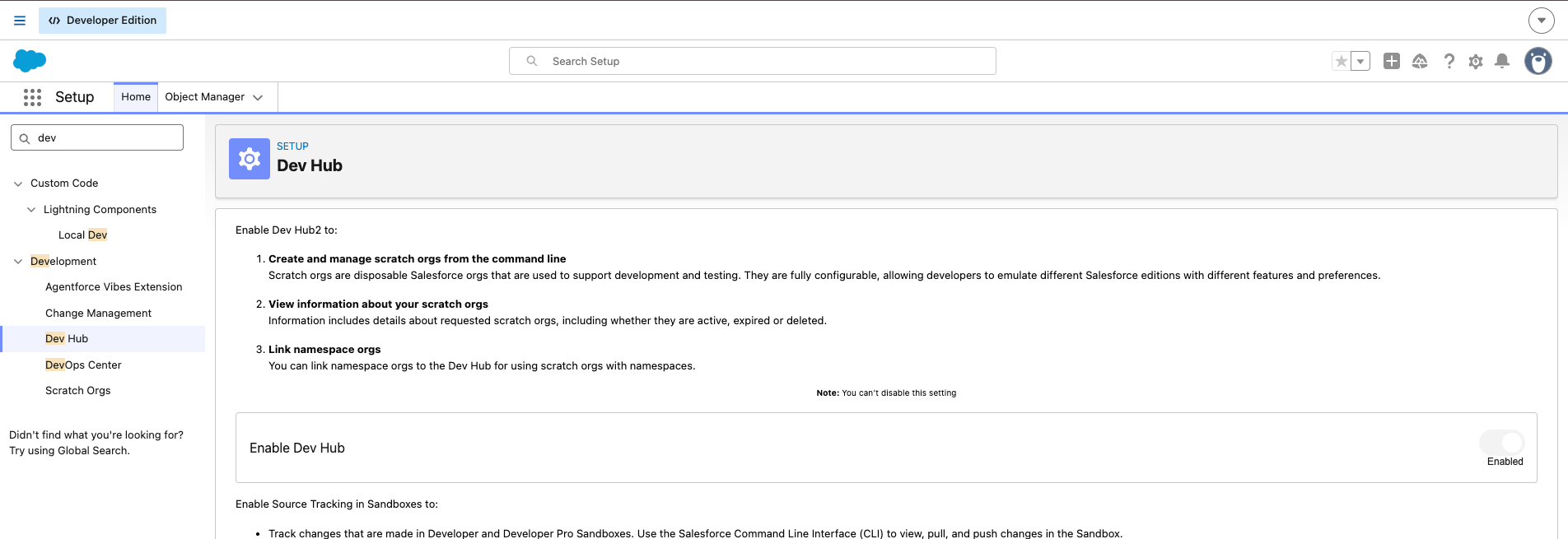
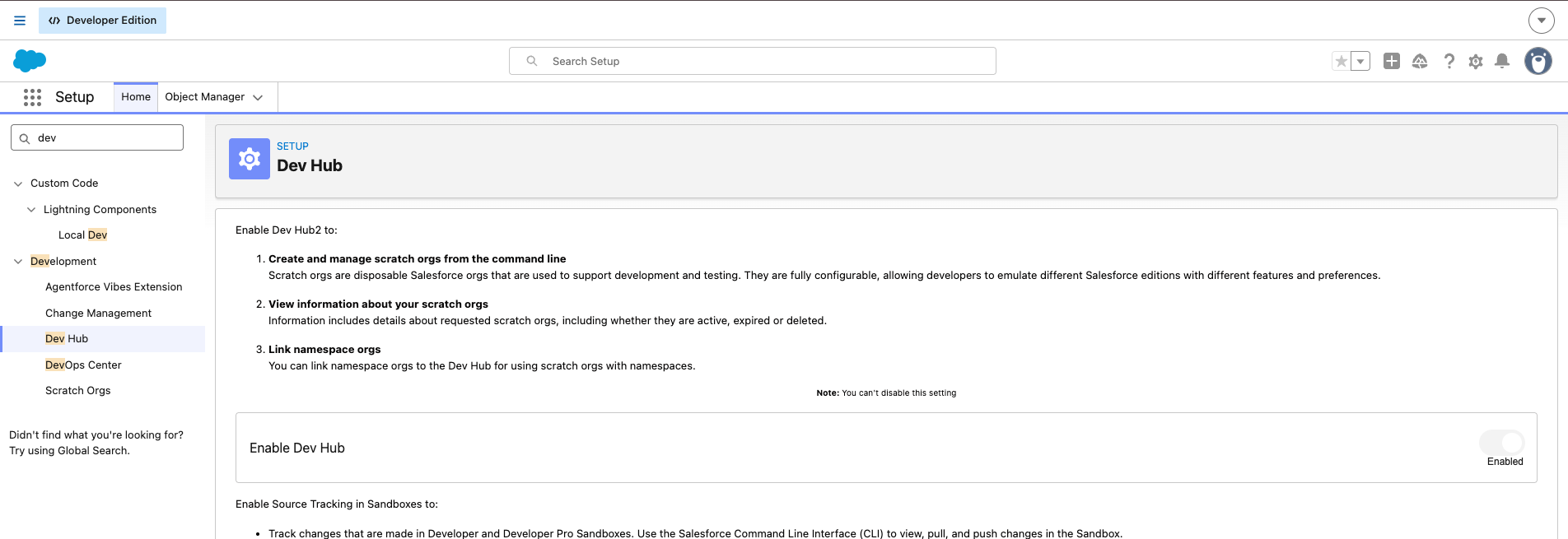
  1. The customer will need to make some changes within their Salesforce to deploy the app. In the SalesForce Dev Hub > Settings > Setup > Dev Hub, enable both 'Enable Unlocked Packages and Second-Generation Managed Packages' and 'Enable Dev Hub'

Screenshot_2026-04-15_at_3.37.45_PM.png

Screenshot_2026-04-15_at_1.44.39_PM.png

  1. Customer deploys the ECA app
sf project deploy start --metadata ExternalClientApplication:APP_API_NAME --target-org TargetOrg
sf project deploy start --metadata ExtlClntAppOauthSettings:APP_API_NAME_oauth --target-org TargetOrg

ℹ️ Replace APP_API_NAME_oauth above with the real OAUTH_SETTINGS_API_NAME from the retrieved file name (it may differ from APP_API_NAME).

Alternative: deploy both metadata types together:

sf project deploy start --metadata ExternalClientApplication --metadata ExtlClntAppOauthSettings --target-org TargetOrg
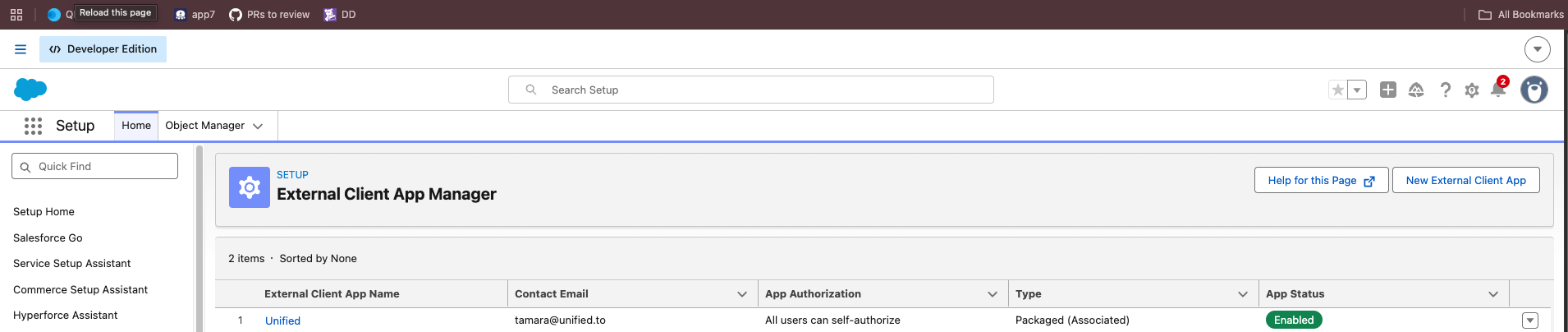
  1. The customer can then verify that the app has been added to their organization by visiting Setup → External Client Apps → external client app manager where they should see your app installed.
Screenshot_2026-04-29_at_11.06.47_AM.png

  1. Configure and approve access in the TargetOrg. The admin should review and configure:
    • Permitted users
    • Profiles / permission sets
    • OAuth policies
    • Refresh token policy
    • IP restrictions, if applicable
    • Admin-approved users, if the org requires admin approval
  2. The customer can now create a connection to your app

Once the app is deployed and access is granted, the end user can retry the normal Salesforce connection flow through Unified and the cross-org OAuth error will be resolved.

Long-term application-distribution recommendation

For repeated customer onboarding, the preferred long-term approach is to package the External Client App as a Salesforce package and share a package install link with customer Salesforce admins, instead of asking each admin to manually run metadata deployment commands.

  1. You create the External Client App once in SourceOrg.
  2. You package the app and OAuth settings.
  3. You share the package install link with customer admins.
  4. The customer Salesforce admin installs the package into TargetOrg.
  5. The customer Salesforce admin approves/configures access.
  6. End users connect normally through OAuth.
Share
All guidesCRM APIsAdvertising Report Metrics by IntegrationATS to Vector DB: How to Power Talent Intelligence with Real-Time DataBuilding AI applications with Unified and LangbaseConcur & Concur (Company) — Connection GuideConfigure Greenhouse Native Candidate WebhooksConnect Amazon Seller Central to Unified.toConnecting BambooHR via OAuth 2Connecting Google Workspace Integrations with a Service AccountCorrect WelcomeKit Scopes for Jungle IntegrationCreating Ads using the Unified Ads APICreating Walmart Items via UnifiedEnd-Users, Integrations, and ConnectionsEnriching Unified Objects with Custom MetadataEnterprise-managed authorization (EMA) with a static keyEnterprise-managed authorization (EMA) with a workspace secretEnterprise-managed authorization (EMA) with Microsoft Entra IDExtended observability — pushing API logs to ClickHouseExtended observability — pushing API logs to Grafana / LokiExtended Observability - Pushing API Logs to your Datadog InstanceFacebook Messenger Webhook SetupFireflies Integration GuideGetting started with WorkableHandling Delegated vs. Application Scopes in Microsoft IntegrationsHiBob & Unified: connection and time off guideHow long are logs retainedHow to access employees and usersHow to add API support for the Create Activity in CrelateHow to Associate a Connection ID with Your End-UserHow to build a Candidate Assessment product with Unified.toHow to build a candidate sourcing or job board app with Unified.toHow to build a Discord support bot with Unified.to and LangbaseHow to Build a Fintech Application with Unified's Payments APIHow to Build an E-Commerce Product Integration with UnifiedHow to build an invoicing system with Unified.toHow to build Enterprise Search using RAGHow to configure Bullhorn Redirect URI for creating a connectionHow to configure webhooks in HubSpotHow to configure webhooks in Thrive LearningHow to configure webhooks in Toast for UnifiedHow to Connect Anthropic to Real-Time SaaS Data with Unified.to MCP ServerHow to Connect Cohere to Real-Time SaaS Data with Unified.to MCP ServerHow to Connect Google Gemini to Real-Time SaaS Data with Unified.to MCP ServerHow to Connect LLMs to Real-Time SaaS Data with Unified.to MCP ServerHow to Connect OpenAI to Real-Time SaaS Data with Unified.to MCP ServerHow to Connect Zoom and Zoom PhoneHow to create a Connection In Microsoft TeamsHow to create a token-based connection in HighlevelHow to Create a Unified.to Connection to HighLevelHow to Create a Xero Connection in Unified.toHow to create and configure webhooksHow to create Connection with HubspotHow to customize portal URLs for Stripe and GoCardlessHow to filter webhook eventsHow-to Get a Private Support Channel for Your Unified IntegrationHow to get your 8x8 Connect API Key and Account ID: Step-by-step guideHow to get your ADP Workforce Now Oauth2 client ID, Oauth2 client secret, Oauth2 PEM certificate and Oauth2 private key: Step-by-step guideHow to get your Amazon S3 AWS Region, AWS S3 Key and AWS S3 Secret: Step-by-step guideHow to get your Ashby API Key: Step-by-step guideHow to get your Brex API token: Step-by-step guideHow to get your Bullhorn OAuth2 Client ID, OAuth2 Client Secret, API Username and API Password: Step-by-step guideHow to get your Ceridian Dayforce Username, Password and Client Namespace: Step-by-step guideHow to get your Crelate API key: Step-by-step guideHow to get your Dashlane API Key: Step-by-step guideHow to get your Deel Access Token: Step-by-step guideHow to get your Dialpad API Key: Step-by-step guideHow to get your Discord OAuth 2 credentials and bot tokenHow to get your ELMO client ID and client secret: Step-by-step guideHow to get your Gainsight Client ID, Client Secret and Gainsight API Domain: Step-by-step guideHow to get your Greenhouse API Key and Job board token: Step-by-step guideHow to get your Helpscout API Key: Step-by-step guideHow to get your HiBob Service User ID and Service User Token: Step-by-step guideHow to get your HighLevel API Key and Location ID: Step-by-step guideHow to get your HubSpot developer key and OAuth 2 credentials (Legacy Apps)How to get your Humaans API Key: Step-by-step guideHow to get your iCIMS API Username, API Password and Customer ID: Step-by-step guideHow to get your JobDiva Client ID, Username/email and Password: Step-by-step guideHow to get your Jobvite API Key, API Key Secret and Email: Step-by-step guideHow to get your Lever API Key: Step-by-step guideHow to get your Loxo Agency slug, API Key and Agency ID: Step-by-step guideHow to get your Microsoft Active Directory / Entra ID Client ID, Client Secret and Tenant ID: Step-by-step guideHow to get your Microsoft Azure AD OAuth 2 credentialsHow to get your OAuth 2 credentials for GmailHow to get your OAuth 2 credentials for Microsoft Dynamics 365How to get your OAuth 2 credentials in PipeDriveHow to get your OpenAI API Key: Step-by-step guideHow to get your Paycom SID/Username and Token/Password: Step-by-step guideHow to get your PCRecruiter Username, Password, Database ID, App Key and App ID: Step-by-step guideHow to get your SAP SuccessFactors (OpenID Connect) Username, Password, Client ID, Client Secret, Dependency Name, IAS Host and API URL: Step-by-step guideHow to get your SAP SuccessFactors Username, Company ID, Password and API URL: Step-by-step guideHow to get your Shopify Admin API access token and Store ID: Step-by-step guideHow to get your Wayfair Client ID, Client Secret and Vendor Encrypted Key: Step-by-step guideHow to get your Workable API Token and Subdomain: Step-by-step guideHow to get your yotpo APP Key / Store ID and Secret Key: Step-by-step guideHow to Handle Attachments in Invoice, Bill and Credit MemoHow to migrate or import your integrations into Unified.toHow to obtain your GitHub OAuth2 credentialsHow to Power Claude with Live Customer Data Using Unified MCPHow to register a Google developer app and get OAuth 2 credentialsHow to register a Salesforce developer app and get OAuth 2 credentialsHow to register a Slack developer account and get OAuth 2 credentialsHow to Register a Workday Developer App and Get OAUTH2 CredentialsHow to Register a Workday Developer App and Get OAUTH2/ SOAP CredentialsHow to Register a ZendeskSell Developer App and Get OAUTH2 CredentialsHow to Register a Zoho Developer App and Get OAUTH2 CredentialsHow to Register an ADP Developer App and Get OAUTH2 CredentialsHow to Register an Atlassian Developer App and Get OAUTH2 CredentialsHow to Register your Facebook OAuth2 ApplicationHow to Register your Google Ads OAuth2 ApplicationHow to Register your MetaAds OAuth2 applicationHow To Request & Write Raw Integration DataHow to Retrieve Microsoft Dynamics 365 Business Central CredentialsHow to set up a custom API URL with a CNAMEHow to Set Up a Microsoft Teams Bot with UnifiedHow to set up and configure NotionHow to set up Google Business Profile API access and get OAuth 2 credentialsHow to Set Up LinkedIn Webhooks with UnifiedHow to set up native webhooks for QuickBooks Online with UnifiedHow to set up Slack webhooks using event subscriptionsHow to set up Telegram (bot) with Unified.toHow to set up your scopes in HubSpotHow to setup a Freshbooks developer appHow to setup a TikTok Shop applicationHow to Setup AWS Assume Role for AWS Secret ManagerHow to setup Oracle JD EdwardsHow to Setup Quickbooks DesktopHow to setup Sage 100 with Unified.toHow to troubleshoot unhealthy connectionsHow to troubleshoot unhealthy webhooksHow to use SCIM with the Unified APIHow to use the Passthrough APIHow to Use Unified.to's Generative AI API with OpenAI and ClaudeHow to use User Provisioning and Verification with UnifiedHow virtual webhook retry and recovery worksIntegration set-up guide for LeverManaging custom validation rules in SalesforceNetSuite Authentication Setup for UnifiedNotice of Deprecation of Fields and Objects (Nov 2025)Oracle HCM / Taleo OAuth Credentials GuideRetrieval-Augmented Generation (RAG)SAML Single-Sign-OnScaling MCP Tools with Anthropic's (& OpenAI's) Defer LoadingSet Environments for your Unified.to WorkspaceSetting up a Slack Bot Connection with Unified.toSetting up OAuth 2 Credentials for Greenhouse's APIsTrello Connection Guide in UnifiedUnderstanding OAuth2 Authorization flowsUnderstanding Response Time Headers in the Unified APIUnified Assessment API: Embed Assessments Inside ATS PlatformsUnified's MCP ServerUnified MCP Server with LangChain and LangGraphUnlock real-time data with virtual webhooksUse Unified to sign in your users into your applicationWorkable: Creating candidates and attaching them to jobsWorkday vs Workday Legacy — Why Unified.to Supports BothWorking with hierarchical tree data in Storage, Messaging, and KMS APIs
Are we missing anything? Let us know
Was this page helpful?